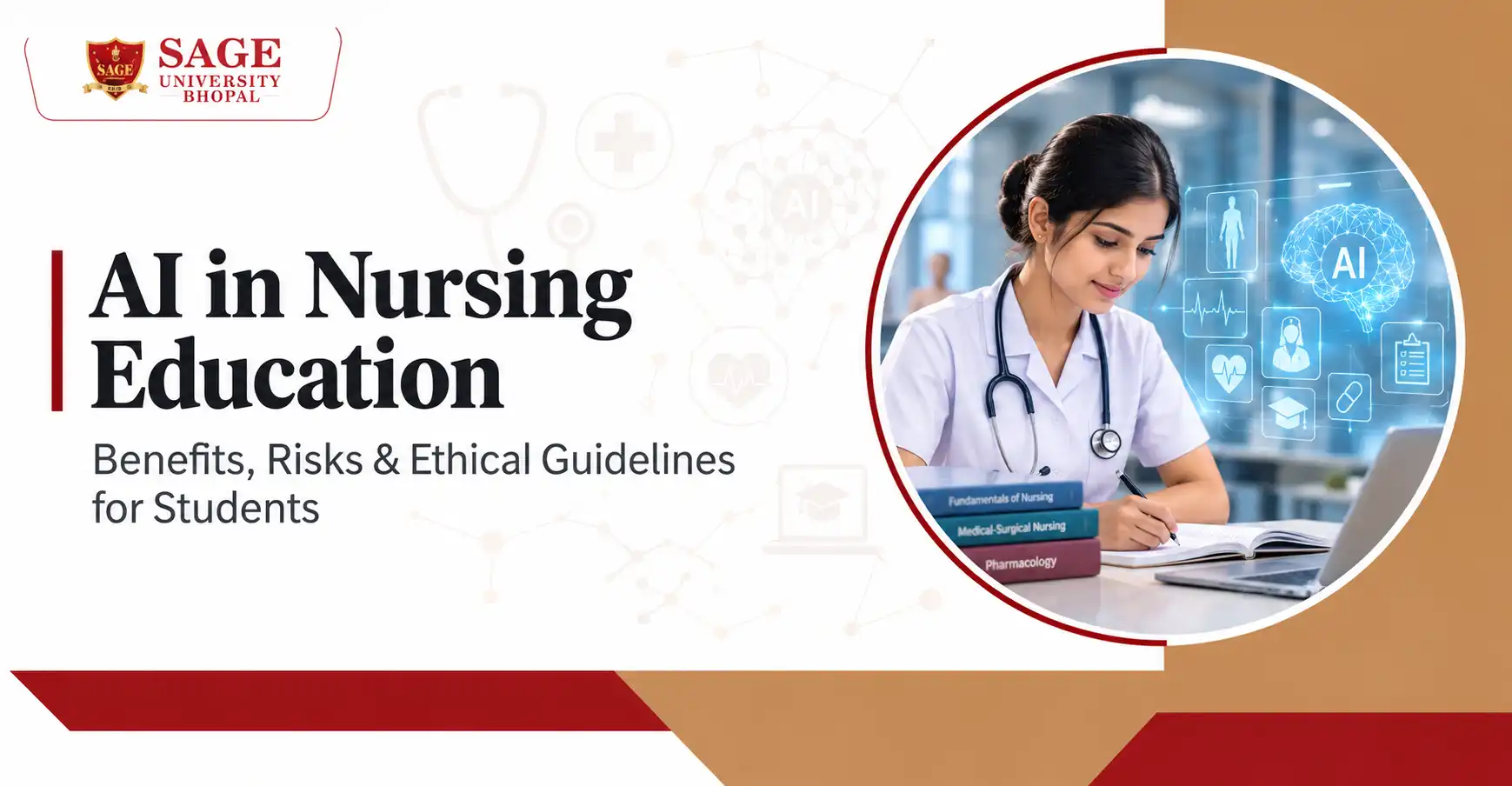
AI in Nursing Education: Benefits, Risks & Ethical Guidelines for Students (2026)
Artificial intelligence (AI) is creating new opportunities for teaching, learning and healthcare. In nursing education, AI-powered tools can help students understand complex concepts, practise clinical scenarios, revise theory subjects and prepare for technology-enabled healthcare settings. At the same time, they raise important questions about patient privacy, academic integrity, bias, accuracy and professional responsibility.
The real challenge is not whether to use AI, but how to use it so that it strengthens learning while protecting the compassion, critical thinking and ethical judgment that nursing demands.
The World Health Organization (WHO) says AI in healthcare should be designed and used with human autonomy, safety, transparency, accountability and equity in mind. These principles apply equally to nursing students who are learning about AI today.
This guide explains how AI is used in nursing education, its benefits and limits, and how students and educators can use it responsibly.
Key Takeaways
• AI can help nursing students revise, practise fictional cases and understand healthcare technology, but only when used with faculty guidance.
• The biggest risks are patient-privacy breaches, biased or incorrect answers, plagiarism and overreliance.
• Never enter real patient information into a public AI tool. Use fictional or de-identified examples.
• Always verify AI answers against prescribed textbooks and approved clinical guidelines.
• AI supports nursing education. It does not replace empathy, clinical judgment or supervised practice.
What Is Artificial Intelligence in Nursing Education?
AI in nursing education means using computer systems that analyse information, generate responses and identify patterns to support selected learning activities, such as revision, practice questions, simulated cases and feedback.
Generative AI is a type of AI that creates new content, such as text, summaries, quiz questions or fictional scenarios, in response to a user's instructions. AI tutors and chatbots are common examples that students may meet during their studies.
It is important to separate two things. AI used for education (for example, a chatbot explaining a concept) is different from AI used in clinical care (for example, a decision-support system analysing patient data). Each has different risks, rules and limitations.
AI should support nursing education. It should never replace faculty guidance, supervised clinical practice or a nurse's own professional judgment.
How Is AI Used in Nursing Education?
1. Personalized Learning and Revision
Students can ask AI to explain difficult topics in simple language, create flashcards or generate practice questions. For example, a student studying the cardiovascular system can ask for a short quiz on blood circulation. The explanations must then be checked against prescribed textbooks and faculty-approved material.
2. Virtual Simulation and Clinical Case Practice
AI-supported exercises can create fictional patient scenarios, ask follow-up questions and help students rehearse communication with patients and families. For example, a student can practise what information to collect from a patient who reports difficulty breathing, how to recognise warning signs and when to call for immediate clinical help. These are learning activities only and do not replace approved simulation training or real patient assessment.
3. Understanding Nursing Concepts and Procedures
AI can explain unfamiliar terms, compare related concepts and organise revision notes in subjects such as anatomy, physiology, pharmacology, infection prevention and patient safety. It can also generate practice problems on medication calculations, but every calculation must be checked independently using the prescribed method.
4. Research and Academic Writing Support
AI may help with brainstorming research questions, organising notes and improving clarity. The student must still read the original research, verify claims, cite real sources and follow the institution's academic-integrity rules. AI-generated references must be checked carefully.
5. Preparing for Technology-Enabled Healthcare
AI is increasingly part of clinical documentation, decision support and health-data analysis. Learning about it helps students question AI recommendations, spot possible errors and raise concerns with the right healthcare professional. The goal is a nurse who works confidently with technology without depending on it.
Types of AI Tools Nursing Students May Encounter
Type of tool
Common student use
Key caution
Conversational AI assistants
Explaining concepts, creating quizzes and flashcards
Can produce confident but wrong answers
AI tutoring platforms
Personalized practice and feedback
Quality varies; check against approved material
Simulation and virtual-case tools
Practising assessment and communication
Not a substitute for supervised simulation or clinical placement
Writing and note-organising tools
Structuring notes and improving clarity
Follow academic-integrity and disclosure rules
Clinical decision-support systems
Alerts, risk scores, documentation prompts (in hospitals)
Used only under authorisation and supervision
What Are the Benefits of AI in Nursing Education?
When tools are chosen carefully, supervised and evaluated, AI may offer these benefits:
• Better access to learning support: Students can revisit hard topics and practise outside class hours.
• More practice opportunities: AI-generated quizzes and fictional cases help identify weak areas.
• Faster organisation of study material: AI can help structure notes and revision plans.
• Support for critical reflection: Good activities ask students to justify answers, spot missing information and compare alternatives.
• Familiarity with digital healthcare: Students understand both the promise and the limits of emerging technologies.
Important Note: These are potential benefits, not guaranteed outcomes. Results depend on the tool, the learning design, faculty supervision and the student's ability to think critically. A 2025 systematic review in Nurse Education in Practice stressed the need for rigorous research evidence on its impact.
What Are the Ethical Issues of AI in Nursing Education?
1. Patient Privacy and Confidentiality
AI tools may store or process what users type. Entering identifiable patient information into an unauthorised AI service can expose confidential data. Never enter patient names, hospital ID numbers, contact details, identifiable photographs or clinical records into an AI tool.
2. AI Bias and Fairness
AI learns from data, and that data can contain gaps and biases. A system may not work equally well for all patient groups. WHO guidance lists inclusiveness, equity, transparency and protection of human rights as key principles for responsible AI in health.
3. Inaccurate Information and Overreliance
Generative AI can give confident, well-written answers that are wrong, incomplete or outdated. In nursing, an error about medication, symptoms or infection prevention can cause serious harm if applied without checking.
4. Academic Integrity and Plagiarism
Submitting an AI-generated assignment as your own work violates academic-integrity rules. What is allowed differs by institution, course and assessment. Follow rules including requirements to disclose AI assistance.
5. Reduced Critical Thinking
Nursing requires assessing information, linking observations, weighing patient needs and justifying decisions. Accepting AI answers without questioning them weakens these vital skills.
6. Loss of Human Empathy
Nursing is more than processing information. It is listening, communication, compassion and respect for patient preferences. The American Nurses Association stresses that AI should support nursing values and must not compromise human interaction.
How Can Nursing Students Use AI Ethically? An 8-Step Checklist
• Check the rules: Know which AI tools and uses are allowed for each assignment, exam or clinical task.
• Protect patient information: Use fictional or de-identified cases only.
• Verify every important claim: Check against textbooks, guidelines and faculty instructions.
• Keep your own judgment: Attempt the problem first and use AI to support learning, not replace it.
• Stay honest: Do not present AI work as your own where rules forbid it. Disclose help where required.
• Check references: Open the original source and confirm authors, title, date and DOI or URL.
• Avoid unsupervised clinical use: A general chatbot is not a substitute for clinical protocols or a qualified supervisor.8
• Question the output: Ask what evidence supports it and what is missing.
Do's and Don'ts at a Glance
DO
• Use AI to revise concepts and create practice quizzes.
• Use fictional or de-identified cases.
• Cross-check with prescribed textbooks and guidelines.
• Verify every citation yourself.
• Ask your faculty when rules are unclear.
DON'T
• Copy AI answers into assignments without permission.
• Enter real patient details into any AI tool.
• Treat AI output as a final clinical answer.
• Use references you have not opened and checked.
• Assume a tool or use is allowed everywhere.
Example: Using AI to Study a Nursing Case
Suppose you are revising a fictional case of an older adult with fever who feels unwell. A good educational prompt would be:
"Create a fictional nursing education case involving an older adult with fever. Ask me questions about initial assessment, observations, patient safety and when escalation may be necessary. After I answer, explain the reasoning and tell me which concepts to review. Do not present this as individual medical advice."
Answer the questions yourself first, check your answers against approved resources, and discuss anything unclear with your faculty. This uses AI for active learning, not as an unquestionable instruction.
What Should Nursing Colleges and Educators Do?
• Set clear AI-use policies: Explain what is allowed in assignments, exams, research and clinical learning, when disclosure is needed and what happens in case of violations.
• Teach AI literacy: Cover limitations such as made-up answers, bias, privacy risks and source verification.
• Protect hands-on competence: AI activities should complement, not replace, practical training, simulation and supervised clinical experience.
• Review tools before adoption: Check accuracy, data handling, accessibility, bias and the need for human oversight.
• Follow human-centred design: UNESCO's guidance on generative AI in education recommends a human-centred approach addressing privacy and ethics.
AI in Nursing Education in India: What Should Students Consider?
For nursing students in India, responsible AI use should follow the rules of the college or university, applicable law and the standards that govern nursing education and practice, including guidelines issued by the Indian Nursing Council (INC).
• Follow institutional rules: Check your college's policies before using AI for coursework, exams or clinical assignments.
• Protect sensitive information: Follow confidentiality rules and data-protection law. The Digital Personal Data Protection Act, 2023 is an important legal reference.
• Use credible clinical sources: Verify explanations against approved textbooks and current guidelines.
• Respect professional boundaries: AI suggestions never replace faculty supervision or authorised procedures.
• Keep care patient-centred: Use technology in ways that support safe, respectful and compassionate care.
How the College of Nursing at SAGE University Bhopal Prepares Students for Technology-Enabled Healthcare
The College of Nursing at SAGE University Bhopal is recognised by the Indian Nursing Council (INC). Its B.Sc Nursing programme is a 4-year, 8-semester course that combines classroom learning, laboratory sessions and clinical training.
• Technology in the curriculum: The syllabus includes Health/Nursing Informatics & Technology in Year 1 and Educational Technology in Year 3.
• Practical exposure: Students gain hands-on experience through health camps, workshops and training linked with Apollo SAGE Hospital.
• Labs and simulation: Provides state-of-the-art laboratories and simulation facilities for skill practice.
• Faculty guidance: Experienced faculty guide students on using technology safely and ethically.
• Career support: A dedicated placement team connects students with leading hospitals and organisations.
What Is the Future of AI in Nursing Education?
AI may play a bigger role in personalized learning, simulated patient interactions, educational feedback and preparation for technology-enabled healthcare. Future tools may include more adaptive simulations and systems that help educators identify learning needs. Their value will depend on evidence of effectiveness, human oversight, accessibility and responsible data use.
Nursing students will need two skills together: using digital tools well, and recognising when those tools are inaccurate, inappropriate or not enough. The future of nursing education should be measured not by how much AI is adopted, but by whether students become more knowledgeable, capable, ethical and compassionate professionals.
Conclusion
AI can support nursing education through personalized learning, simulated case practice, revision help and exposure to emerging healthcare technology. These benefits must be balanced against privacy risks, bias, misinformation, academic-integrity concerns and overdependence on automated systems.
Responsible use needs clear institutional policies, evidence-based resources, faculty guidance and active student participation. Above all, technology must remain a support for nursing education, never a replacement for the knowledge, empathy, accountability and human connection that define quality nursing care.
Ready to Start Your Nursing Career?
Explore the B.Sc Nursing programme at SAGE University Bhopal or apply online.
Frequently Asked Questions About AI in Nursing Education
1. What is AI in nursing education?
AI in nursing education is the use of artificial intelligence tools to support teaching, learning, simulation, revision and selected assessments. These tools supplement traditional instruction but do not replace supervised clinical training.
2. How is AI used in nursing education?
AI can generate practice questions, explain difficult concepts, support simulated patient scenarios, organise study notes and assist with permitted research tasks. Its output should always be checked against reliable sources.
3. What are the benefits of AI in nursing education?
Potential benefits include personalized learning support, extra practice, faster organisation of study material and familiarity with digital healthcare. Results depend on tool quality and supervision.
4. What are the ethical issues of AI in nursing education?
Major concerns are patient privacy, algorithmic bias, inaccurate information, plagiarism, academic-integrity breaches, overreliance on technology and loss of independent reasoning.
5. Can nursing students use ChatGPT for assignments?
Students may be able to use ChatGPT for permitted activities such as brainstorming, concept clarification and revision. Whether it can be used for a particular assignment depends on the institution's rules. Work must never be submitted as your own.
6. Can AI replace nurses or nursing educators?
No. AI can support selected educational and clinical tasks, but it cannot replace professional judgment, supervised skill development, accountability or compassionate human interaction.
7. How can nursing students use AI safely?
Follow institutional policies, avoid entering confidential patient information into unauthorised tools, verify clinical claims, check references, disclose AI help when required and seek qualified supervision.
8. What is the future of AI in nursing education?
AI may increasingly support adaptive learning, virtual simulations, educational feedback and digital healthcare training. Long-term value will depend on evidence, ethical governance, privacy safeguards and continued development of clinical competence.
9. Is the College of Nursing at SAGE University Bhopal recognised by the INC?
Yes. According to SAGE University Bhopal, its College of Nursing is recognised by the Indian Nursing Council (INC).
10. Does the B.Sc Nursing syllabus at SAGE University include technology training?
Yes. The syllabus includes Health/Nursing Informatics & Technology in Year 1 and Educational Technology in Year 3.
References
[1] World Health Organization. (2021). Ethics and governance of artificial intelligence for health: WHO guidance.
[2] Ma, J., Wen, J., Qiu, Y., et al. (2025). The role of artificial intelligence in shaping nursing education: A comprehensive systematic review. Nurse Education in Practice, 84, 104345.
[3] American Nurses Association. (2022). The Ethical Use of Artificial Intelligence in Nursing Practice. Position statement.
[4] Miao, F., & Holmes, W. (2023). Guidance for generative AI in education and research. UNESCO.
[5] Government of India. (2023). The Digital Personal Data Protection Act, 2023.
To attain global distinction through value-based holistic research, creativity, innovation and Entrepreneurship.
To provide holistic education through innovative teaching learning pedagogy.